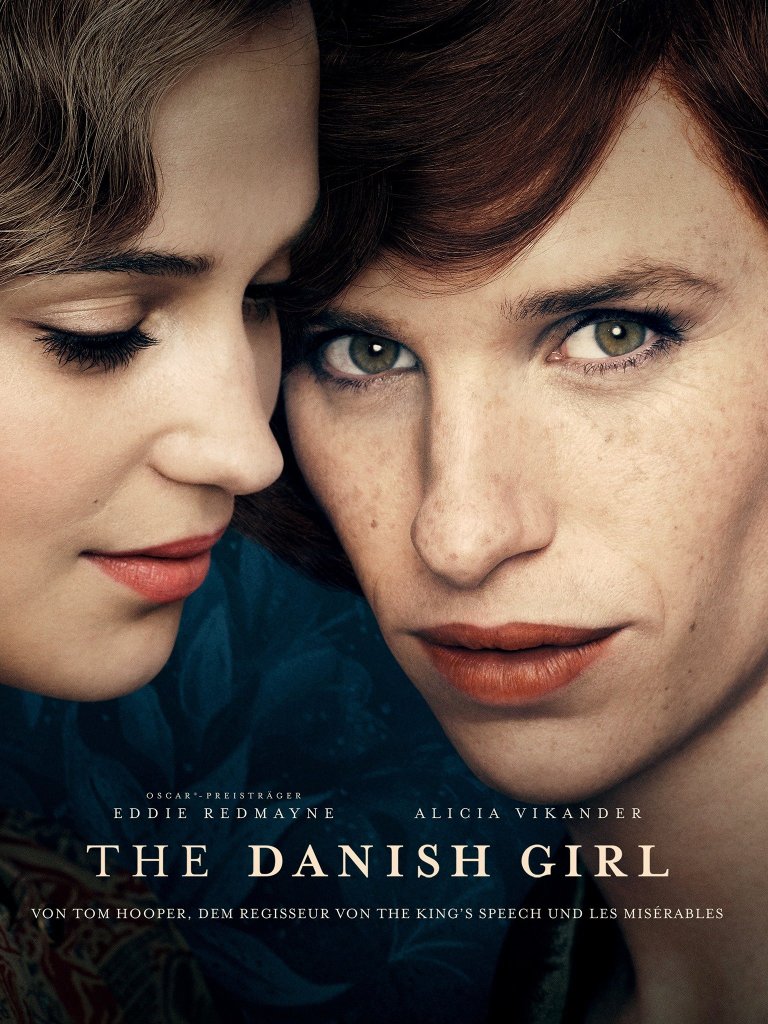

The Danish Girl, directed by Tom Hooper, is truly a film to be celebrated. It is inspired by the true story of transgender woman Lili Elbe, who in the 1930s, was the first person in the world recorded to have undergone gender reassignment surgery. It is an amazing film and presents the issues of gender dysphoria and stigmas around transgender people in such a clear way with the help of amazing acting performances from Eddie Redmayne and Alicia Vikander, who won an Oscar for best supporting actress in this movie.
The film opens with famous painter Einar Wegener, played by Eddie Redmayne, being asked by his wife Gerda, played by Alicia Vikander, to stand in for her model and pose for her painting. Einar is at first reluctant to pose as a woman but once he is given a dress, his eyes light up with happiness as if this is the first time when he is truly allowed to be himself.
As the film progresses we see Einar becoming more and more comfortable as Lili, and as Garda’s muse. Lili dresses stylishly and is a truly beautiful woman attracting lots of male attention as her feminine self. You can clearly see her becoming more and more comfortable in her identity, so much so that she makes the decision to see a doctor about living life as a woman. The doctor seems supportive at first, but things soon take a darker turn when Gerda opens a letter recommending that Einar be committed to an insane asylum. This attitude was representative of much of the general public at this time, who did not understand or accept transgender people and instead just viewed them as insane. They then run away to Paris where Gerda has started to gain recognition due to her portraits of Lili. Here, Lili truly flourishes and we see her copying women’s actions and expressions to be more feminine. These copied actions help start a journey towards Lili realising her true self, which is a truly beautiful thing.
There are many instances of gender dysphoria in The Danish Girl, and it is evident that Lili’s male genitalia is causing her to become increasingly distressed. She feels as if she cannot truly become a woman until her biological self is fully female. She then starts to see doctors in France about her struggles with gender dysphoria, many of whom do not help or understand her, until she meets Dr. Warnekros, played by Sebastian Koch, who tells her about the possibility of gender reassignment surgery.
After hearing about the many risks and complications of the surgeries, Gerda is hesitant pleading Lili not to go through with them; however Lili immediately agrees as she feels it is the final step before she can be complete and soon after she travels to Germany to begin the surgery. Gerda joins Lili after her first surgery and they travel back to Copenhagen together where Lili thrives. She works in a department store selling perfume and we see her making new friends and she seems far, far happier than ever before.
It is evident that Gerda misses Einar and begs Lili to allow him to return and speak to her, but Lili tells her that Einar is dead and cannot come back as she is finally who she should be. She then travels back to Germany and undergoes her second surgery. Gerda again joins her after this surgery with Einar’s childhood friend Hans, played by Matthias Schoenaerts, however she finds Lili gravely ill after complications with the surgery have caused her to lose a lot of blood. Lili tells Gerda that she finally feels complete and insists on being taken out to the garden with her and Hans. After a heartwarming conversation between the two of them, Lili dies whilst holding Gerda’s hand.
The movie ends with Hans and Gerda travelling back to Hans and Einar’s childhood town Vejle, and they stand in front of the lake that inspired many of Einar’s portraits. Garda’s scarf that has been exchanged between Lili and Gerda for the majority of the movie, flies off of her neck and Hans chases after it. Gerda however tells him to leave it and the last scene is a shot of the scarf flying away in the wind, which is perhaps a symbolism of Lili finally feeling free enough to let go of her old self and Gerda accepting that Einar is gone forever.
This is a sensational movie and one that I would definitely recommend to everyone. It clearly shows the issue of gender dysphoria that many transgender people deal with and it is a truly beautiful depiction of a transgender woman finally feeling like her full self. Transphobia and homophobia are shown multiple times throughout the film, from doctors calling Einar insane for wanting to change his gender, to Einar getting beat up by two men in Paris who repeatedly probe him, asking him to tell them his gender. I think these scenes are extremely important as they very effectively portray the real life issue of transphobia that many people still face today, almost 100 years after the film is set. It is also exquisitely filmed. As Einar starts to transition into a woman, we see that the lighting gets brighter to reflect the happiness that Lili finally feels inside. Lili also wears much more extravagant, bright clothes than Einar which shows how she feels much more free and joyful when she is living as her true self.
Although this film is loosely based on the real life story of Lili Elbe, there are many events in her life that are not reflected in the film, such as the fact that Lili was in fact intersex. This means that before transitioning, she possessed ovaries. If you want a more accurate account of Lili Elbe’s transition and life, I would recommend reading her autobiography, ‘Man Into Woman: A Comparative Scholarly Article.’ Although the film is not completely historically accurate, it is still one of my personal favourites and in my opinion, one of the best movies out there so it is definitely one you should watch!
 Film Analyser
i love this sounds like a really good film
LikeLike
Thanks Emily, I’ve never seen this film, but will definitely watch it after your review.
LikeLike
A magnificent film. A beautiful story and celebration of bravery.
LikeLike
This is an extremely eloquently written essay 5/5
LikeLike
nice
LikeLike
Sounds good will have to check out
LikeLike
great film !
LikeLike
Sensitive review of a film dealing with a difficult situation in the 1930s yet sadly current today.
LikeLike