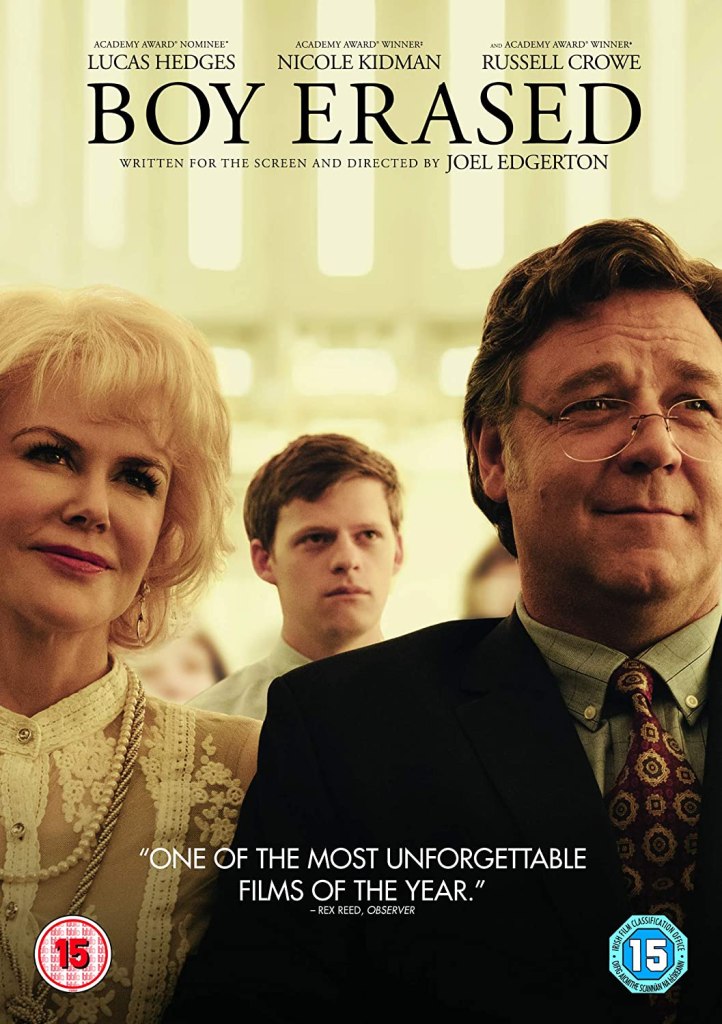

Boy Erased

Boy Erased, directed by Joel Edgerton, is a dramatic film based on the real-life story of Garrard Conley and his experiences with America conversion therapy. It is a stark film that tells Garrard’s story in a very real, emotional way and it is truly one to watch.

In Boy Erased 18 year old Jared Eamons (based on Garrard), played by Lucas Hedges is shown struggling to come to terms with his sexuality in a deeply religious home where his father Marshall, played by Russell Crowe, is the preacher in their local church.

At the start of the film we see Jared during his first day at Love In Action, a conversion therapy programme. From the start, the programme seems very dubious: people that have enrolled are not allowed their phones whilst they are being ‘treated’ and they are discouraged from telling anyone outside of the programme about what goes on inside it. Victor Sykes, played by Joel Edgerton, is the chief therapist at Love In Action and he tells the group that their homosexuality is a sin and a choice and that God will never love them as they are. Victor then instructs each member of the group to make a genogram based on any issues that the member’s families may have had in the past such as drug addiction and gang affiliation as he says it would have ‘triggered’ their homosexuality.

We then see a flashback to Jared’s life before Love In Action when he was in college. He quickly befriended a fellow student called Henry, played by Joe Alwyn, and they become closer; hanging out, running and going to church together. One night Henry stayed over in Jared’s dorm and in a particularly hard to watch scene, he raped Jared. After doing so he apologises profusely and explains to Jared that he has raped another young man that he met at church. Jared is extremely shaken up and returns home. This is an extremely important moment in the film and although graphic was necessary to include. Men being raped has a lot of stigma around it and it is hardly ever represented in media so this representation while traumatic is key in bringing light to the fact that people of all genders can be raped. In the aftermath of this moment, we see Jared struggling profusely within himself. He seems incapable of anything often staring blankly into space and hardly communicating at all with his parents, showing the effect of rape in a very clever, respectful way.

One night Henry poses as a counsellor at Jared’s college and calls Jared’s parents and outs him, fearing that Jared would reveal what he did. Jared denies it at first and says that he loves God too much to be homosexual but he finally comes to term with it and tells his parents. They react very badly, his mother Nancy, played by Nicole Kidman, sobs quietly whilst his father invites pastors round to pray for his son. Jared’s father then asks him if he is willing to change and when Jared says he wants to change, his father arranges for him to be sent to conversion therapy.

The film then cuts back to the present and we see different members of the group talking about their ‘sins of homosexuality’. One of the boys Gary, played by Troye Sivan, tells Jared that he has to pretend he is changing if he ever wants to leave the programme and if not he will forced to be stay in accommodation made specifically for members that don’t respond to conversion therapy. We then see another of the members Cameron, played by Britton Sear, in an exercise where Victor encourages him to unleash his anger, confront his sins and express his willingness for change. However Cameron refuses and things quickly take an even darker turn.

He is forced to attend an imitation of his own funeral where he is shouted at by the leaders of Love In Action who tell him that if he continues with his homosexual tendencies, he will end up dead and in Hell. Victor then encourages Cameron’s family and friends to strike him with a bible to ‘beat the sin out of him’. Cameron then returns to the group and tells Victor that he now has God in his heart as he is terrified of being abused for his sexuality again.

When it is Jared’s tun to confess he talks about when he stayed over with a boy, but they did nothing more than hold hands. Victor calls him a liar and tries to force him to talk about Henry but he refuses and begins to get angry telling Victor he hates him and running out of the room. He takes his phone and calls his mother begging her to pick him up. She arrives and sees Jared held back and locked into a room by Victor and some of the other leaders. She rescues him and drives him to the motel they have been staying at. After a conversation with his father, she tells Jared that he wants him to return to conversion therapy. However she tells him that she will protect him and that he will never have to go back there again. Once home, the police knock on Jared’s door and it is revealed that Cameron, much like many young LGBT people forced into conversion therapy, has committed suicide whilst still being a member of Love In Action.

Four years on we see Cameron happy in New York and finally comfortable within himself and with his sexuality surrounded by friends and in a happy relationship. He returns home and the film ends with Jared and his father beginning to fix their relationship as his father says he is willing to try and change his homophobic ways as he doesn’t want to lose his son.

This film is one of the best representations of conversion therapy an internalised homophobia that I have ever seen. It presents the obvious problem with the idea of changing a person’s sexuality in such a clear, excellent way and does not shy away from portraying the real problems that Garrard, who the film is based on, had to deal with. Whilst there are laws in place against conversion therapy, it has not been officially been banned in many states yet and as a result more than 650,000 American adults have been forced to go to conversion therapy which is a truly shocking statistic. This film is incredibly important as it brings more awareness to the inhuman treatment of people that are forced to go to conversion therapy. This type of therapy is incredibly harmful and causes many suicides each year and it is something that needs to be banned as soon as possible.

The only negative thing I would say about this film is that we never get to see Jared’s journey towards accepting his homosexuality. I think this would have been a beautiful part of the film and an addition of this kind would have made the film even more amazing. That being said, this film is still sensational and deeply provocative, and the way that it not only highlights many issues with homophobia and conversion therapy, but also shows how happy people can become when they come to terms with their sexuality makes it definitely worth the watch.
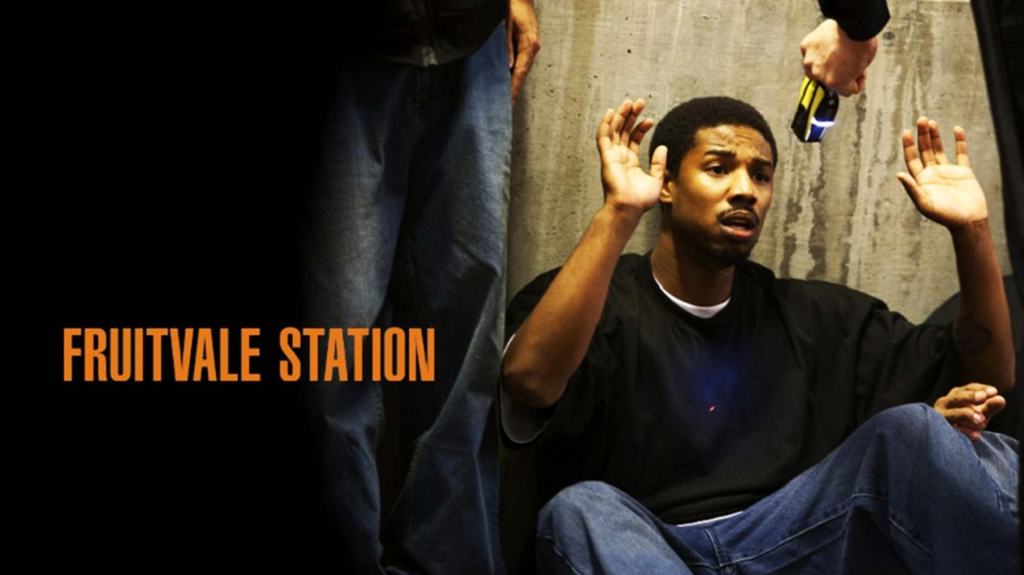

Fruitvale Station

Fruitvale Station, directed by Ryan Coogler, is an emotive and powerful movie that is definitely worth the watch. It is a largely biographical movie based on the fatal shooting of Oscar Grant on The Bay Area Transit Platform (BART) in Oakland, California on January 1st 2009, and it depicts the reality of racism and police brutality in America in a very effective, real way.

The film opens with the harrowing video of the real-life footage of the shooting of Oscar by police. It then cuts to the film version of Oscar, played by Michael B. Jordan, on the last day before his death. Oscar and his girlfriend Sophina, played by Melonie Diaz, are fighting about Oscar not being faithful to her and he promises to be better. Their daughter Tatiana, played by Ariana Neal, tells Oscar that she cannot sleep so she sleeps in their room.

We then see Oscar at the store that he supposedly works at and find out that he has been fired for tardiness. He begs his boss for his job back but he says no and Oscar begs him saying the only alternative is drug dealing, however his old boss still refuses.

Oscar then calls one of his clients and tells him he can sell him some marijuana. He then drives into a petrol station and befriends a Pit Bull who ends up getting run over by some men. This is symbolic of the fact that African-Americans get killed by police and life, for the most part, just seems to move on showing a complete disregard for life. The fact that the dog is a Pit Bull is perhaps also symbolic as they are a dog breed that are often portrayed in an extremely unsympathetic, negative way in the media just like some African-American men are.

He then drives to the sea where he dumps his stash of marijuana, which shows a change in his attitude and proves that he was ready to become a better person and leave his life of crime behind. The film then cuts to his time in prison and shows a visitation between him and his mother Wanda, played by Octavia Spencer, as she tells him she won’t visit him any longer until he gets out of prison. We also see an altercation between him and another prisoner before Wanda leaves. He then gets back in his car and tells his client that he has already sold his marijuana but gives him a smaller amount for free. The fact that he refuses payment also proves that he is done with dealing.

Oscar and his family then got to his mother’s birthday party where she tells him to take the BART train into the city rather than driving as it will be quicker and safer. They enter the city and have an amazing time, partying and befriending people. After celebrating New Year’s with his friends and his girlfriend in the city he returns to the train with them and begins the journey home.

The prisoner that was fighting with Oscar in the prison flashback is also on the train, he sees him and a fight breaks out between the two. Police are called for back up and Oscar’s friends are forced to the ground by white police officers. Oscar runs back on the train but is hauled out by an officer. They repeatedly tell the officers that they have done nothing but the officers do not listen. Oscar then shouts at one of the officers who has called him a racial slur. He is then crushed by an officer kneeling on his neck and shot in the back by another officer, which is an extremely shocking scene. He is rushed to hospital where his friends and family wait anxiously for news about him from the doctors. This is representative of the damage that police brutality has on external forces such as friends and families. The doctor then brings the sad news that Oscar has died after losing too much blood. The film then cuts to facts about the real murder and videos of a protest for Oscar’s death in 2013. The truly shocking fact that the officer who shot Oscar told the jury that he mistook his gun for his taser and as a result he only spent 11 months in jail is revealed.

This film is an emotional yet very effective movie. It portrays the real-life issue of police racism and brutality and the unfair treatment that they receive. This is a prominent issue and the racism of some of the police force is despicable. The rate of police shootings of Black Americans is higher than any other ethnicity, 37 per million people; and from 2013 to 2021, 2391 Black Americans were killed by police which is a truly chilling statistic.

This film is definitely one to watch as it presents the problem of racism amongst American police in such a shocking, emotive and powerful way; so I would say it is definitely one to watch.

The Danish Girl

The Danish Girl, directed by Tom Hooper, is truly a film to be celebrated. It is inspired by the true story of transgender woman Lili Elbe, who in the 1930s, was the first person in the world recorded to have undergone gender reassignment surgery. It is an amazing film and presents the issues of gender dysphoria and stigmas around transgender people in such a clear way with the help of amazing acting performances from Eddie Redmayne and Alicia Vikander, who won an Oscar for best supporting actress in this movie.

The film opens with famous painter Einar Wegener, played by Eddie Redmayne, being asked by his wife Gerda, played by Alicia Vikander, to stand in for her model and pose for her painting. Einar is at first reluctant to pose as a woman but once he is given a dress, his eyes light up with happiness as if this is the first time when he is truly allowed to be himself.

As the film progresses we see Einar becoming more and more comfortable as Lili, and as Garda’s muse. Lili dresses stylishly and is a truly beautiful woman attracting lots of male attention as her feminine self. You can clearly see her becoming more and more comfortable in her identity, so much so that she makes the decision to see a doctor about living life as a woman. The doctor seems supportive at first, but things soon take a darker turn when Gerda opens a letter recommending that Einar be committed to an insane asylum. This attitude was representative of much of the general public at this time, who did not understand or accept transgender people and instead just viewed them as insane. They then run away to Paris where Gerda has started to gain recognition due to her portraits of Lili. Here, Lili truly flourishes and we see her copying women’s actions and expressions to be more feminine. These copied actions help start a journey towards Lili realising her true self, which is a truly beautiful thing.

There are many instances of gender dysphoria in The Danish Girl, and it is evident that Lili’s male genitalia is causing her to become increasingly distressed. She feels as if she cannot truly become a woman until her biological self is fully female. She then starts to see doctors in France about her struggles with gender dysphoria, many of whom do not help or understand her, until she meets Dr. Warnekros, played by Sebastian Koch, who tells her about the possibility of gender reassignment surgery.

After hearing about the many risks and complications of the surgeries, Gerda is hesitant pleading Lili not to go through with them; however Lili immediately agrees as she feels it is the final step before she can be complete and soon after she travels to Germany to begin the surgery. Gerda joins Lili after her first surgery and they travel back to Copenhagen together where Lili thrives. She works in a department store selling perfume and we see her making new friends and she seems far, far happier than ever before.

It is evident that Gerda misses Einar and begs Lili to allow him to return and speak to her, but Lili tells her that Einar is dead and cannot come back as she is finally who she should be. She then travels back to Germany and undergoes her second surgery. Gerda again joins her after this surgery with Einar’s childhood friend Hans, played by Matthias Schoenaerts, however she finds Lili gravely ill after complications with the surgery have caused her to lose a lot of blood. Lili tells Gerda that she finally feels complete and insists on being taken out to the garden with her and Hans. After a heartwarming conversation between the two of them, Lili dies whilst holding Gerda’s hand.

The movie ends with Hans and Gerda travelling back to Hans and Einar’s childhood town Vejle, and they stand in front of the lake that inspired many of Einar’s portraits. Garda’s scarf that has been exchanged between Lili and Gerda for the majority of the movie, flies off of her neck and Hans chases after it. Gerda however tells him to leave it and the last scene is a shot of the scarf flying away in the wind, which is perhaps a symbolism of Lili finally feeling free enough to let go of her old self and Gerda accepting that Einar is gone forever.

This is a sensational movie and one that I would definitely recommend to everyone. It clearly shows the issue of gender dysphoria that many transgender people deal with and it is a truly beautiful depiction of a transgender woman finally feeling like her full self. Transphobia and homophobia are shown multiple times throughout the film, from doctors calling Einar insane for wanting to change his gender, to Einar getting beat up by two men in Paris who repeatedly probe him, asking him to tell them his gender. I think these scenes are extremely important as they very effectively portray the real life issue of transphobia that many people still face today, almost 100 years after the film is set. It is also exquisitely filmed. As Einar starts to transition into a woman, we see that the lighting gets brighter to reflect the happiness that Lili finally feels inside. Lili also wears much more extravagant, bright clothes than Einar which shows how she feels much more free and joyful when she is living as her true self.

Although this film is loosely based on the real life story of Lili Elbe, there are many events in her life that are not reflected in the film, such as the fact that Lili was in fact intersex. This means that before transitioning, she possessed ovaries. If you want a more accurate account of Lili Elbe’s transition and life, I would recommend reading her autobiography, ‘Man Into Woman: A Comparative Scholarly Article.’ Although the film is not completely historically accurate, it is still one of my personal favourites and in my opinion, one of the best movies out there so it is definitely one you should watch!

mid90s

Jonah Hill made his directional debut with the movie mid90s, a coming-of-age comedy-drama set in 1990s Los Angeles. Hill drew on inspiration from his own childhood in the 1990s and this is evident from the clear sense of nostalgia throughout the movie. Hill was a keen skateboarder in the 90s and said that he wanted to properly represent skate culture in the 90s so decided to not only include moments from his own childhood, but also that all of the skating actors in the movies would be people who were skateboarders in real life.

The movie is based on a young boy, Stevie who lives with his older brother Ian, who is extremely abusive, and his single mother Dabney. The movie starts with a harrowing scene of Stevie being abused by Ian. One day Stevie sees a group of four skaters in a skate shop and returns home and begs his brother for a skateboard. He then goes to the skate shop and befriends the four skaters: Ruben, Ray, F*cksh*t and Fourth Grade. They teach him how to skate and take him under their wing, taking him everywhere with them including to parties.

When Stevie comes home intoxicated after a party, him and Ian get into a fight and Ian has a mental breakdown when Stevie points out his lack of friendships. His mother then bans him from hanging out with the other boys, but Stevie rebels and goes back to the skate shop. There, him and Ray have a heart-warming conversation about how the other boys help each other with their tough moments in life and he then takes Stevie out skating all night.

The skate shop then hosts a movie, where F*cksh*t gets incredibly intoxicated and tries to embarrass Ray in front of the pro-skaters who are trying to recruit him and Ruben and Stevie get into a fight in front of all of the other partygoers. F*cksh*t then attempts to drive the boys home, while still being incredibly drunk which results in a car crash and Stevie in a hospital bed.

The movie ends with reconciliation, Ian and Stevie are finally on the same page and their relationship is improving, Dabney allows the skaters to go and see Stevie after seeing them waiting for him in the hospital waiting room. The skaters then watch the movie, entitled ‘mid90s’, that Fourth Grade has been filming for the duration of the film and the movie ends with them all skating in Fourth Grade’s movie.

In mid90s, we see Sunny Suljic (a professional skateboarder and child actor) in his first ever lead role. He did an excellent job of portraying a young boy with many emotional and family troubles. The other skaters in the film: Ray, F*cksh*t, Ruben and Fourth Grade are also all professional skaters which helps to make the film seem more natural and realistic. Lucas Hedges portrays Stevie’s abusive older brother, and his acting is so good in this movie that you forget he is acting and it seems more like a documentation of a brother’s abusive behaviour. Katherine Waterson and Alexa Demie also star as Stevie’s mother and a girl with which Stevie has his first sexual experience respectively.

I think that this movie deserves four stars because it is very entertaining, very realistic, has many likeable characters – many of whom have excellent character development, and it also has a very good plot. The soundtrack is also a large reason for the amount of enjoyability in this film as as well as its own original music, it features many songs from the 1990s such as “Passin’ Me By” by “The Pharcyde” and “93 ‘Til Infinity” by “Souls Of Mischief” which definitely place the film in the 90s and give it a more nostalgic feel. There is also clever symbolism in the movie, such as orange juice which is used throughout the movie to represent the power dynamic of Stevie and Ian’s relationship. At the start of the movie, we see Ian drinking orange juice when he is being abusive towards Stevie and it is evident that he is the one with the power in the relationship. In Stevie and Ian’s big fight, we see Stevie injuring Ian and causing him to have a breakdown, and we see Stevie drinking the orange juice which represents the the power dynamic has now shifted so that Stevie is the one with the power. By the end of the movie, Stevie and Ian have reached equilibrium in their relationship. They both have a mutual respect and understanding of each other, and this is represented by them both drinking orange juice together as they are now on the same level of authority and power.

The reason I think that this movie is deserving of four stars instead of five is simply that there were many unanswered questions in the movie and many things that could have been developed and talked about more. An example of this is Stevie’s self-harm throughout the movie: there are many instances in mid90s where Stevie hurts himself in order to rid himself of guilt and punish himself but we never see how this started or whether it ends or continues. All the skaters also have their own issues that aren’t really talked about like Fourth Grade’s poverty, F*cksh*t’s drug addiction and alcohol abuse and Ruben’s abusive drug addicted mother. I feel like if these things were developed further the movie would have been even better and it would have been deserving of five stars.

Overall, I would say that mid90s is definitely worth watching as it is a very enjoyable movie and one of my own personal favourites. I would however say there are quite a few hard to watch, uncomfortable scenes throughout the movie. These include the previously mentioned abuse of Stevie by his brother and Stevie’s self harm, and also a long, sexual scene featuring Stevie and a much older girl. But if you can get over these things, then I would say this film is definitely one to watch!