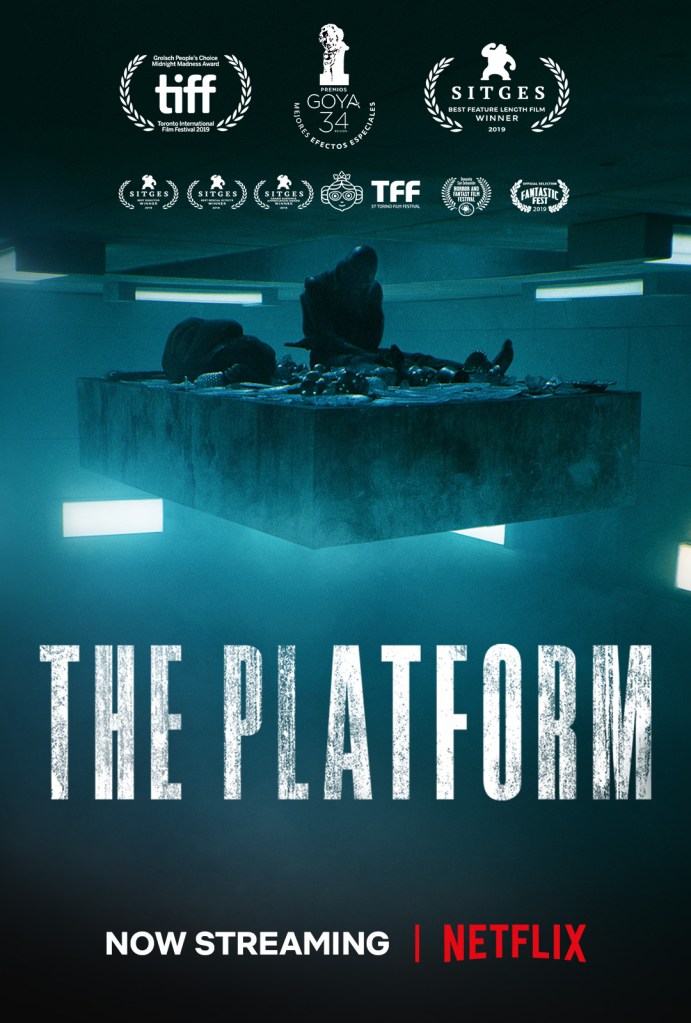

Galder Gaztelu-Urrutia, a Spanish director born in Bilbao, made his feature film debut in 2019 with The Platform or El Hoyo in Spanish. The Platform is a Spanish dystopian horror film which many people view as a social commentary on the flaws of capitalist societies. The director, Gatzelu-Urrutia, said that the key message of the film is that “humanity will have to move towards the fair distribution of wealth.” This theme is evident throughout the movie, which gives it a much deeper, much more intelligent feel than most horror films.
The film starts with Goreng, played by Iván Massagué, waking up in a concrete cell marked with the number 48. He then realises he is not alone, and begins to question his cellmate Trimagasi, played by Zorion Eguileor, who explains that they are in a Vertical Self-Management Centre nicknamed The Pit. The Pit is a tower-shaped building in which food is placed on a floating platform and delivered to each level where it stops for a short time before continuing to descend. Food can also not be kept when the platform descends, and if it is the cell is heated or cooled to extreme temperatures until the food has gone again. The idea is essentially that as the platform descends, the food lessens so the people at the lower levels will go hungry and are at a disadvantage which reflects the disadvantage placed on people at the bottom of capitalist societies.
Each inhabitant is assigned to a new level at random at the start of each month and each resident is allowed to bring one item inside the facility with them. Goreng brought a copy of Don Quixote, whilst Trimagasi chose to bring a self-sharpening knife. He then reveals to Goreng that when he was assigned to level 132 with his former cellmate, they killed and ate one of the other inhabitants of The Pit in order to survive. A woman named Miharu, played by Alexandra Masangkay, then rides down on the platform and Trimagasi tells Goreng that she descends the levels of the facility on the platform each month to search for her child. It is then revealed that Goreng is in the facility as a volunteer but Trimagasi is serving a one year sentence for manslaughter.
When Goreng wakes up relocated to level 171, he finds himself tied up by Trimagasi who explains that since no food will come to them, they must eat strips of Goreng’s flesh in order to survive. A few days pass and as Trimagasi is growing weaker, in a particularly gruesome scene, he starts to cut into Goreng’s leg before he is attacked by Miharu who then frees Goreng. He then kills Trimagasi.
He then wakes up on level 33 with a woman named Imoguiri, played by Antonia San Juan, who is revealed to be one of the administrators of the facility. She tries to make changes within the facility telling the people below to only take what they need so that everyone can get food, but no one listens until Goreng threatens them. He awakes the next month on level 202 and sees that Imoguiri has hanged herself; he becomes overwhelmed and plagued by hallucinations of Trimagasi and Imoguiri encouraging Goreng to eat her flesh in order to survive, and in the end he does.
In the next month he is assigned to level 6 with a new cellmate Baharat, played by Emilio Buale Coka, who he convinces to ride down on the platform so that everyone can get a portion of the food. They descend until level 333 where they find Miharu’s daughter, who Miharu has been delivering food to each month so that she can survive. Goreng passes out and has a vision of Baharat telling him that the girl is the message. When he wakes up, he finds Baharat dead and he takes the child to the platform and puts her on and stands back and watches as she ascends on the platform.
This movie is definitely worth five stars as not only is it an extremely enjoyable movie, but it also has many clever hidden messages within it. The most obvious one is the commentary on the flaws of capitalist society, like the fact that the people on the first few levels are treated to a lavish buffet whilst the people on the lower levels get nothing at all, but there are many other deeper messages too. The girl could be described as the message because she is the only one who can make a change within the facility. In terms of real life, this could reflect the viewpoint that young people are the only thing that can save and develop society as they bring in a new way of thinking that can make real change. Even the characters names have meaning behind them: Goring means “fried” in Indonesian which points towards the fact that The Pit may in fact be a physical representation of Hell, Imoguiri is named after Imogiri which is a Javanese cemetery in Indonesia which emphasises that her, along with her colleagues are willingly sending people to their deaths. Finally, Miharu which means “to guard” or “to open one’s eyes” in Japanese emphasises her role as the guardian of her child who will change the inhabitants of The Pit’s way of life. Personally, I think it is one of the best horror movies out there and it is another one of my favourite movies so I would say that it is definitely worth watching.
The only thing I would point out is the level of graphicness depicted in the movie. There are several gruesome, violent scenes throughout, which are clearly used to depict the brutality of society, but I don’t think these take away from the enjoyability of the movie. So if you can cope with some violence, then I would absolutely recommend this movie.
 Film Analyser