Dallas Buyers Club

Dallas Buyers Club, directed by Jean-Marc Vallée, is an absolutely sensational film that displays the brave and highly emotional story of Ron Woodroff, played by Matthew McConaughey, after he was diagnosed with AIDS in 1986. Although not entirely accurate, this film is highly biographic and portrays the struggles and bravery of AIDS victims in a classy yet very raw and very real way.

The film tells the story of Ron Woodroff, a man who indulges in a highly promiscuous lifestyle in Dallas, Texas. From the very beginning of the film, it is evident that he is very sick but it is not until Ron is sent to hospital that we see what his illness actually is.

The doctors tell him that they have run some blood work on him and that he has tested HIV positive and as a result he has just 30 days left to live. Ron reacts very badly by shouting homophobic slurs and being in complete denial about his illness. This was not uncommon at the time, as there were such stigmas surrounding HIV and AIDS that people would simply avoid contact with anyone who had contracted this so called “gay disease.” However, Ron then remembers having unprotected sex with a drug abusing prostitute a few years prior and he realises that his doctors have diagnosed him correctly.

We then see the horrors that homosexual people faced at this time firsthand when we see that Ron has been cut off completely from his friends, fired from his job and even evicted from his home. This film portrays the struggles that, not just people who were diagnosed with AIDS, but also homosexual people in general faced in such an effective, sensitive way and this is one of the reasons that this film is so excellent.

We then see Ron at the hospital where Dr Eve Saks, played by Jennifer Garner, tells him about a clinical trial for a new AIDS drug called AZT but tells him that it likely won’t be available for at least a year after they have finished testing it. We are then introduced to Jared Leto’s character Rayon, although a completely fictional character, she is hugely loveable and her story is so heart wrenching and emotive that her presence really adds to the film. Rayon plays cards with Ron and ignores his homophobic insults and this is when we see the beginning of a truly pure friendship.

Ron, desperate for anything that will help to prevent him from dying, bribes a hospital worker to give him AZT. However, the AZT worsens his condition and actually almost kills him. On the brink of death, he drives to a makeshift hospital in Mexico where he is told that AZT essentially kills every last healthy cell that a person living with AIDS has. Ron’s conditions improve after he is given a mix of drugs by one of the doctors working at this hospital and this is when he gets the idea to form his Dallas Buyers Club.

Ron, after seeing the benefits of the drugs that he has been given, decides to buy some and over the course of the next year, begins to sell them to every person that is suffering with AIDS and that is willing to pay that he can find. It is then that he comes into contact with Rayon again and agrees to become business partners with her as he knows that she will be able to bring him more customers. This is when their buyers club becomes fully established and we see their business flourishing as they have people queued right outside their room waiting for the drugs.

However, the two main antagonists, Richard Barkley, played by Michael O’Neill, and Dr Sevard, played by Denis O’Hare, catch wind of Rayon and Ron’s work and proceed to seize their drugs and fine Ron. Here, we see one of the most emotional moments in the film where Rayon goes to her transphobic father and begs him for money so that she and Ron can continue to help people. Their interaction is very affecting and the way in which Rayon’s father talks to her is truly shocking.

Ron then travels to Mexico to acquire more drugs and upon returning he learns that Rayon has died from AIDS. Ron is truly affected by this news and in this moment we see that he truly has changed into a more humane understanding individual. He begins to give out treatment more willingly to AIDS patients even though it costs him money personally and we see a real humility within him that has not been there previously.

In the end, Ron files a lawsuit against the FDA as he wants to continue to take Peptide T, one of the drugs that has helped him to survive. In the end, the judge does not have the power to do anything but it is revealed in the end that Ron was allowed by the FDA to take Peptide T for the last few years of his life. He later died from AIDS in 1992, an incredible 7 years longer than the doctors projected.

This film is truly one to be celebrated. In my opinion, it shows the struggles with AIDS and the misunderstandings and stigmas that surrounded it in such an incredible way and it handles such difficult topics in an incredibly sensitive, fresh way. Matthew McConaughey’s portrayal of the hero Ron Woodroff is sensational and I think that he really does adds to the film with his sensational acting; the other most notable performance is from Jared Leto in his portrayal of Rayon. In his acting, we see the struggles that many transgender people face not just from others but also internally; as we see Rayon struggles deeply with a cocaine addiction and with an evident hatred for her prior self. One of the most emotional scenes, is where we see her putting her makeup on again after speaking with her father, and she says that when she dies and sees God, she wants him to see her in her most beautiful form. In this moment, we see a true acceptance for herself which is an incredibly beautiful thing to witness. These two actors depict this incredible story in such an amazing way and make this film as brilliant as it is.

There really aren’t any negatives to this film, apart from perhaps that a large percentage of it is fictional. That being said, there are many news articles that you can read if you want to learn the whole, true story about Ron, and I believe that the fictional elements actually add to the film and make it even better than it would have been without them. This film is truly one to watch and, as it is a personal favourite of me, one that I really, really recommend that you watch!


Girl, Interrupted

Girl, Interrupted, directed by James Mangold, is based on the real life account of Susanna Kayser’s 18 month stay in a psychiatric hospital following a suicide attempt in the 1960’s. It is an incredible film, portraying many different mental health issues such as depression, OCD, anorexia and borderline personality disorder.

The film opens with Susanna, played by Winona Ryder, being checked into the psychiatric hospital, Claymoore, following a suicide attempt. One of the most prevalent things throughout the film and in this moment is Susanna’s denial of her suicide attempt. Although she ingests a lethal dosage of aspirin and follows it with a bottle of vodka, she consistently tells the people around her that she was merely ‘trying to get rid of a headache’ when in actuality her reasoning is much darker. This displays the denial that many people had at this time and still do today after a suicide attempt and displays the importance of seeking help after one of these incidences.

Once at Claymore, Susanna, although extremely antisocial and awkward, befriends many of the patients. One of her first friends is Polly Clark, played by Elisabeth Moss, a seemingly innocent schizophrenic burn victim whose trauma has enabled her to act in an extremely childish way for the entirety of the film. Her other friends are: Georgina Tuskin, played by Cleara DuVall, Susanna’s roommate who is a pathological liar, Daisy Random, played by Brittany Murphy, who has OCD, bulimia, and who frequently self harms, and Janet, played by Angela Bettis, a depressed and skeptic anorexic. Susanna then meets Lisa Rowe, played by Angelina Jolie, a sociopath who constantly escapes the institution.

Georgina tells Susanna that Lisa is very volatile and abusive and we see this from the very start of the film in the way that she treats Daisy. Susanna is in Daisy’s room when Lisa bursts in and immediately begins to belittle her. She exposes Daisy’s use of laxatives to Susanna and makes fun of her afterwards. Lisa then discovers dozens of chicken carcasses under Daisy’s bed, which she explains are from her father who sells poultry. Hiding food is a behaviour that is very common amongst people suffering with bulimia, and this moment provides an insight into just how severe the mental health issues that people were suffering with at Claymoore were.

We then see Susanna in her therapy sessions with Dr Potts, Jeffrey Tambor, these continue for a few weeks until she is diagnosed with borderline personality disorder, characterised by unstable relations, extreme emotions, and volatile reactions. Susanna remains in denial about this for the majority of the film and constantly tells Dr Potts that she does not need to be in Claymoore and that she was merely sent there for a rest. Another symptom of borderline personally disorder is strong sexual urges and a constant need for sexual intimacy which is displayed throughout the film in a series of flashbacks. We see that she has had a relationship with a man she met in a bar, a college professor, and later, an orderly at the hospital.

After Lisa and Susanna are punished for falling asleep with an orderly and not spending the night in their rooms, they escape and run away to Daisy’s apartment that her father has bought her. They bribe her with valium so Daisy allows them to stay. This is when we get a proper insight into Lisa’s sociopathic nature. Although Daisy insists that she is doing well and no longer self harms, Lisa grabs her arm and reveals deep cuts down her arm; however instead of helping her, she makes fun of Daisy. Daisy, obviously upsets starts to climb up the stairs when Lisa says, in perhaps the most horrific moment of the film, that Daisy enjoys the sexual abuse that she suffers due to her father.

The next morning, it is shown that Daisy has committed suicide due to Lisa’s words. Susanna is horrified but Lisa shows neither shock nor remorse. Instead, she begins to search Daisy’s room and her body for any cash. This is when Susanna realises that she does not want to end up like Lisa and so she returns to Claymoore, and begins to co operate and work harder in therapy. Lisa is eventually caught and taken back to Claymoore where she bullies Susanna and chases her down a corridor where Susanna tells her that she is a cold, unemotional person. Lisa is so affected by this that she contemplates committing suicide. She is however dissuaded by the other patients and in the final moment of the film, we see Susanna and Lisa reconciling before Lisa is released.

This is a truly incredible film. It portrays mental health issues in such a real way without glamorising them which is something that a lot of films nowadays are guilty of doing. As this film, is based on the real life experience of Susanna Kayser, it provides an insight into how psychiatric wards were at this point and shows the huge improvements in terms of treatments that we have today. Between 1960 and 1980, the suicide rate per 100,000 in America was 19.9 per year for men and 6.5 per year for women. This statistic although shocking emphasises how many people, specifically men, feared seeking help, and as a result turned to suicide. Although this film was set 60 years ago, it is still important to watch as it helps to further remove stigmas around mental health whilst also avoiding glamorising them and trying to cover up some of the harsher symptoms. This film is definitely one that I would recommend and I think that it is so important to watch a film like this, that portrays mental health issues so effectively and also shows the importance in receiving help for these issues.

The only issue that I have with this film is that quite a lot of it is evidently dramatised. The only character that we actually see leave the hospital and seemingly doing okay is Susanna which makes the success rates of treatment not particularly high when in reality they were fairly effective even at this time. So if I could improve one thing in this film, I would definitely say that seeing how the characters were in a few years would definitely improve this already amazing film. It is also rather graphic at times, specifically regarding Daisy’s suicide and self-harm, but if this is not an issue for you or something that you do not mind watching then I would definitely recommend watching this film as it is excellent and one of my personal favourites.

Boy Erased

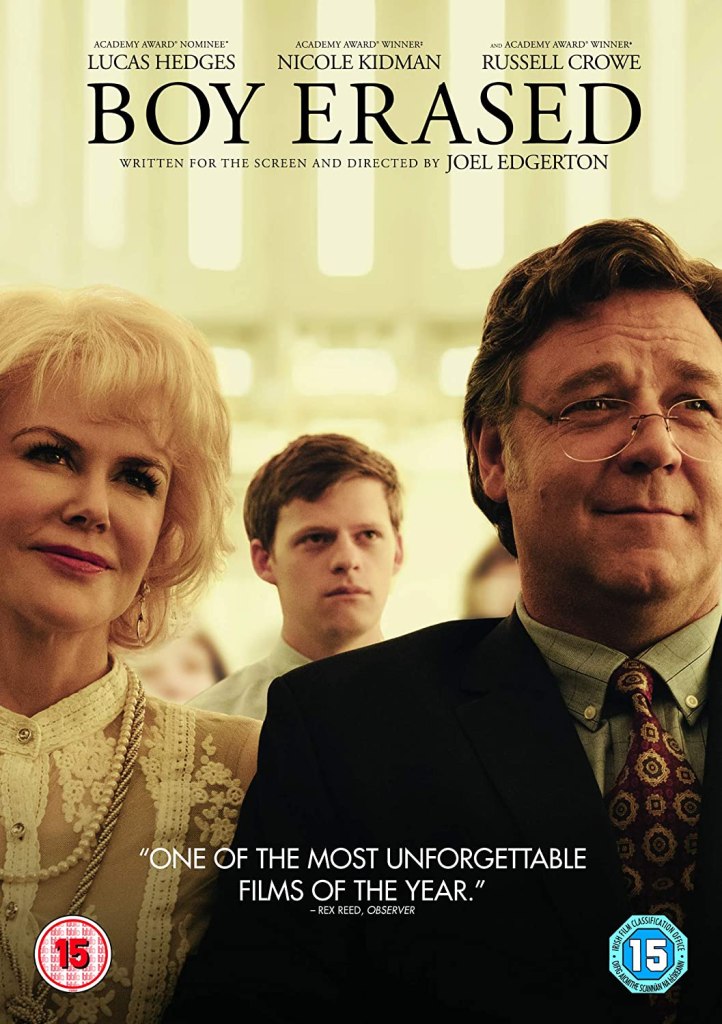
Boy Erased, directed by Joel Edgerton, is a dramatic film based on the real-life story of Garrard Conley and his experiences with America conversion therapy. It is a stark film that tells Garrard’s story in a very real, emotional way and it is truly one to watch.

In Boy Erased 18 year old Jared Eamons (based on Garrard), played by Lucas Hedges is shown struggling to come to terms with his sexuality in a deeply religious home where his father Marshall, played by Russell Crowe, is the preacher in their local church.

At the start of the film we see Jared during his first day at Love In Action, a conversion therapy programme. From the start, the programme seems very dubious: people that have enrolled are not allowed their phones whilst they are being ‘treated’ and they are discouraged from telling anyone outside of the programme about what goes on inside it. Victor Sykes, played by Joel Edgerton, is the chief therapist at Love In Action and he tells the group that their homosexuality is a sin and a choice and that God will never love them as they are. Victor then instructs each member of the group to make a genogram based on any issues that the member’s families may have had in the past such as drug addiction and gang affiliation as he says it would have ‘triggered’ their homosexuality.

We then see a flashback to Jared’s life before Love In Action when he was in college. He quickly befriended a fellow student called Henry, played by Joe Alwyn, and they become closer; hanging out, running and going to church together. One night Henry stayed over in Jared’s dorm and in a particularly hard to watch scene, he raped Jared. After doing so he apologises profusely and explains to Jared that he has raped another young man that he met at church. Jared is extremely shaken up and returns home. This is an extremely important moment in the film and although graphic was necessary to include. Men being raped has a lot of stigma around it and it is hardly ever represented in media so this representation while traumatic is key in bringing light to the fact that people of all genders can be raped. In the aftermath of this moment, we see Jared struggling profusely within himself. He seems incapable of anything often staring blankly into space and hardly communicating at all with his parents, showing the effect of rape in a very clever, respectful way.

One night Henry poses as a counsellor at Jared’s college and calls Jared’s parents and outs him, fearing that Jared would reveal what he did. Jared denies it at first and says that he loves God too much to be homosexual but he finally comes to term with it and tells his parents. They react very badly, his mother Nancy, played by Nicole Kidman, sobs quietly whilst his father invites pastors round to pray for his son. Jared’s father then asks him if he is willing to change and when Jared says he wants to change, his father arranges for him to be sent to conversion therapy.

The film then cuts back to the present and we see different members of the group talking about their ‘sins of homosexuality’. One of the boys Gary, played by Troye Sivan, tells Jared that he has to pretend he is changing if he ever wants to leave the programme and if not he will forced to be stay in accommodation made specifically for members that don’t respond to conversion therapy. We then see another of the members Cameron, played by Britton Sear, in an exercise where Victor encourages him to unleash his anger, confront his sins and express his willingness for change. However Cameron refuses and things quickly take an even darker turn.

He is forced to attend an imitation of his own funeral where he is shouted at by the leaders of Love In Action who tell him that if he continues with his homosexual tendencies, he will end up dead and in Hell. Victor then encourages Cameron’s family and friends to strike him with a bible to ‘beat the sin out of him’. Cameron then returns to the group and tells Victor that he now has God in his heart as he is terrified of being abused for his sexuality again.

When it is Jared’s tun to confess he talks about when he stayed over with a boy, but they did nothing more than hold hands. Victor calls him a liar and tries to force him to talk about Henry but he refuses and begins to get angry telling Victor he hates him and running out of the room. He takes his phone and calls his mother begging her to pick him up. She arrives and sees Jared held back and locked into a room by Victor and some of the other leaders. She rescues him and drives him to the motel they have been staying at. After a conversation with his father, she tells Jared that he wants him to return to conversion therapy. However she tells him that she will protect him and that he will never have to go back there again. Once home, the police knock on Jared’s door and it is revealed that Cameron, much like many young LGBT people forced into conversion therapy, has committed suicide whilst still being a member of Love In Action.

Four years on we see Cameron happy in New York and finally comfortable within himself and with his sexuality surrounded by friends and in a happy relationship. He returns home and the film ends with Jared and his father beginning to fix their relationship as his father says he is willing to try and change his homophobic ways as he doesn’t want to lose his son.

This film is one of the best representations of conversion therapy an internalised homophobia that I have ever seen. It presents the obvious problem with the idea of changing a person’s sexuality in such a clear, excellent way and does not shy away from portraying the real problems that Garrard, who the film is based on, had to deal with. Whilst there are laws in place against conversion therapy, it has not been officially been banned in many states yet and as a result more than 650,000 American adults have been forced to go to conversion therapy which is a truly shocking statistic. This film is incredibly important as it brings more awareness to the inhuman treatment of people that are forced to go to conversion therapy. This type of therapy is incredibly harmful and causes many suicides each year and it is something that needs to be banned as soon as possible.

The only negative thing I would say about this film is that we never get to see Jared’s journey towards accepting his homosexuality. I think this would have been a beautiful part of the film and an addition of this kind would have made the film even more amazing. That being said, this film is still sensational and deeply provocative, and the way that it not only highlights many issues with homophobia and conversion therapy, but also shows how happy people can become when they come to terms with their sexuality makes it definitely worth the watch.

Fruitvale Station

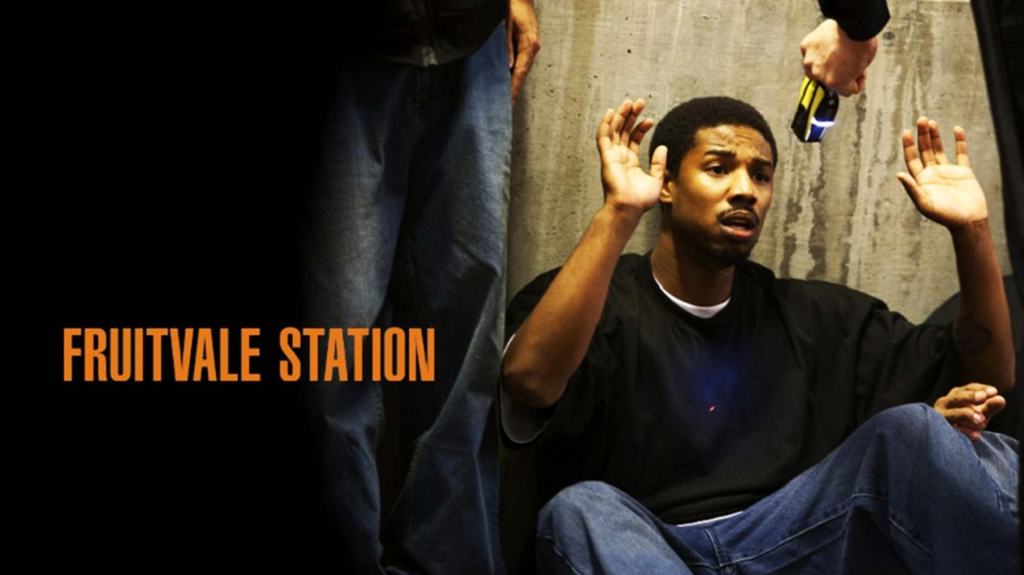
Fruitvale Station, directed by Ryan Coogler, is an emotive and powerful movie that is definitely worth the watch. It is a largely biographical movie based on the fatal shooting of Oscar Grant on The Bay Area Transit Platform (BART) in Oakland, California on January 1st 2009, and it depicts the reality of racism and police brutality in America in a very effective, real way.

The film opens with the harrowing video of the real-life footage of the shooting of Oscar by police. It then cuts to the film version of Oscar, played by Michael B. Jordan, on the last day before his death. Oscar and his girlfriend Sophina, played by Melonie Diaz, are fighting about Oscar not being faithful to her and he promises to be better. Their daughter Tatiana, played by Ariana Neal, tells Oscar that she cannot sleep so she sleeps in their room.

We then see Oscar at the store that he supposedly works at and find out that he has been fired for tardiness. He begs his boss for his job back but he says no and Oscar begs him saying the only alternative is drug dealing, however his old boss still refuses.

Oscar then calls one of his clients and tells him he can sell him some marijuana. He then drives into a petrol station and befriends a Pit Bull who ends up getting run over by some men. This is symbolic of the fact that African-Americans get killed by police and life, for the most part, just seems to move on showing a complete disregard for life. The fact that the dog is a Pit Bull is perhaps also symbolic as they are a dog breed that are often portrayed in an extremely unsympathetic, negative way in the media just like some African-American men are.

He then drives to the sea where he dumps his stash of marijuana, which shows a change in his attitude and proves that he was ready to become a better person and leave his life of crime behind. The film then cuts to his time in prison and shows a visitation between him and his mother Wanda, played by Octavia Spencer, as she tells him she won’t visit him any longer until he gets out of prison. We also see an altercation between him and another prisoner before Wanda leaves. He then gets back in his car and tells his client that he has already sold his marijuana but gives him a smaller amount for free. The fact that he refuses payment also proves that he is done with dealing.

Oscar and his family then got to his mother’s birthday party where she tells him to take the BART train into the city rather than driving as it will be quicker and safer. They enter the city and have an amazing time, partying and befriending people. After celebrating New Year’s with his friends and his girlfriend in the city he returns to the train with them and begins the journey home.

The prisoner that was fighting with Oscar in the prison flashback is also on the train, he sees him and a fight breaks out between the two. Police are called for back up and Oscar’s friends are forced to the ground by white police officers. Oscar runs back on the train but is hauled out by an officer. They repeatedly tell the officers that they have done nothing but the officers do not listen. Oscar then shouts at one of the officers who has called him a racial slur. He is then crushed by an officer kneeling on his neck and shot in the back by another officer, which is an extremely shocking scene. He is rushed to hospital where his friends and family wait anxiously for news about him from the doctors. This is representative of the damage that police brutality has on external forces such as friends and families. The doctor then brings the sad news that Oscar has died after losing too much blood. The film then cuts to facts about the real murder and videos of a protest for Oscar’s death in 2013. The truly shocking fact that the officer who shot Oscar told the jury that he mistook his gun for his taser and as a result he only spent 11 months in jail is revealed.

This film is an emotional yet very effective movie. It portrays the real-life issue of police racism and brutality and the unfair treatment that they receive. This is a prominent issue and the racism of some of the police force is despicable. The rate of police shootings of Black Americans is higher than any other ethnicity, 37 per million people; and from 2013 to 2021, 2391 Black Americans were killed by police which is a truly chilling statistic.

This film is definitely one to watch as it presents the problem of racism amongst American police in such a shocking, emotive and powerful way; so I would say it is definitely one to watch.

The Danish Girl

The Danish Girl, directed by Tom Hooper, is truly a film to be celebrated. It is inspired by the true story of transgender woman Lili Elbe, who in the 1930s, was the first person in the world recorded to have undergone gender reassignment surgery. It is an amazing film and presents the issues of gender dysphoria and stigmas around transgender people in such a clear way with the help of amazing acting performances from Eddie Redmayne and Alicia Vikander, who won an Oscar for best supporting actress in this movie.

The film opens with famous painter Einar Wegener, played by Eddie Redmayne, being asked by his wife Gerda, played by Alicia Vikander, to stand in for her model and pose for her painting. Einar is at first reluctant to pose as a woman but once he is given a dress, his eyes light up with happiness as if this is the first time when he is truly allowed to be himself.

As the film progresses we see Einar becoming more and more comfortable as Lili, and as Garda’s muse. Lili dresses stylishly and is a truly beautiful woman attracting lots of male attention as her feminine self. You can clearly see her becoming more and more comfortable in her identity, so much so that she makes the decision to see a doctor about living life as a woman. The doctor seems supportive at first, but things soon take a darker turn when Gerda opens a letter recommending that Einar be committed to an insane asylum. This attitude was representative of much of the general public at this time, who did not understand or accept transgender people and instead just viewed them as insane. They then run away to Paris where Gerda has started to gain recognition due to her portraits of Lili. Here, Lili truly flourishes and we see her copying women’s actions and expressions to be more feminine. These copied actions help start a journey towards Lili realising her true self, which is a truly beautiful thing.

There are many instances of gender dysphoria in The Danish Girl, and it is evident that Lili’s male genitalia is causing her to become increasingly distressed. She feels as if she cannot truly become a woman until her biological self is fully female. She then starts to see doctors in France about her struggles with gender dysphoria, many of whom do not help or understand her, until she meets Dr. Warnekros, played by Sebastian Koch, who tells her about the possibility of gender reassignment surgery.

After hearing about the many risks and complications of the surgeries, Gerda is hesitant pleading Lili not to go through with them; however Lili immediately agrees as she feels it is the final step before she can be complete and soon after she travels to Germany to begin the surgery. Gerda joins Lili after her first surgery and they travel back to Copenhagen together where Lili thrives. She works in a department store selling perfume and we see her making new friends and she seems far, far happier than ever before.

It is evident that Gerda misses Einar and begs Lili to allow him to return and speak to her, but Lili tells her that Einar is dead and cannot come back as she is finally who she should be. She then travels back to Germany and undergoes her second surgery. Gerda again joins her after this surgery with Einar’s childhood friend Hans, played by Matthias Schoenaerts, however she finds Lili gravely ill after complications with the surgery have caused her to lose a lot of blood. Lili tells Gerda that she finally feels complete and insists on being taken out to the garden with her and Hans. After a heartwarming conversation between the two of them, Lili dies whilst holding Gerda’s hand.

The movie ends with Hans and Gerda travelling back to Hans and Einar’s childhood town Vejle, and they stand in front of the lake that inspired many of Einar’s portraits. Garda’s scarf that has been exchanged between Lili and Gerda for the majority of the movie, flies off of her neck and Hans chases after it. Gerda however tells him to leave it and the last scene is a shot of the scarf flying away in the wind, which is perhaps a symbolism of Lili finally feeling free enough to let go of her old self and Gerda accepting that Einar is gone forever.

This is a sensational movie and one that I would definitely recommend to everyone. It clearly shows the issue of gender dysphoria that many transgender people deal with and it is a truly beautiful depiction of a transgender woman finally feeling like her full self. Transphobia and homophobia are shown multiple times throughout the film, from doctors calling Einar insane for wanting to change his gender, to Einar getting beat up by two men in Paris who repeatedly probe him, asking him to tell them his gender. I think these scenes are extremely important as they very effectively portray the real life issue of transphobia that many people still face today, almost 100 years after the film is set. It is also exquisitely filmed. As Einar starts to transition into a woman, we see that the lighting gets brighter to reflect the happiness that Lili finally feels inside. Lili also wears much more extravagant, bright clothes than Einar which shows how she feels much more free and joyful when she is living as her true self.

Although this film is loosely based on the real life story of Lili Elbe, there are many events in her life that are not reflected in the film, such as the fact that Lili was in fact intersex. This means that before transitioning, she possessed ovaries. If you want a more accurate account of Lili Elbe’s transition and life, I would recommend reading her autobiography, ‘Man Into Woman: A Comparative Scholarly Article.’ Although the film is not completely historically accurate, it is still one of my personal favourites and in my opinion, one of the best movies out there so it is definitely one you should watch!

What Ever Happened To Baby Jane?

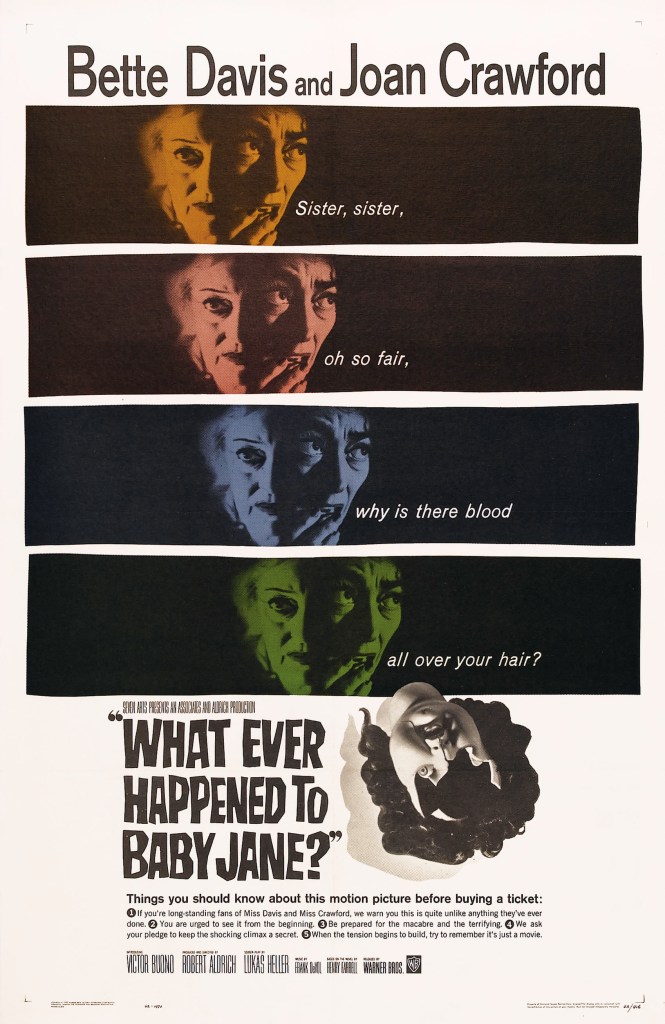
‘What Ever Happened To Baby Jane?’ is one of the first psychological horror-thrillers ever made and it is definitely one of the best. Bette Davis and Joan Crawford are portrayed in a far more sinister light in this film, directed by Robert Aldrich, and their acting skills are phenomenal.

The movie opens in 1917 with “Baby Jane” Hudson, played by Bette Davis, as a bratty and spoilt child star. She performs for huge crowds and is loved so much that she begins to sell doll replicas of herself to the public. Her and her father, played by Dave Willock, are haughty and bully Jane’s sister Blanche, played by Joan Crawford. They feel that they are better than her as they are the ones making the money. Blanche and Jane’s mother, played by Anne Barton, makes Blanche promise that when she becomes famous she will treat her father and Jane far more kindly than they treat her and Blanche promises to do so.

Fast forward to 1935 and we find that Jane is no longer famous and is instead consumed by alcoholism while Blanche has become a famous star. We see that Blanche has indeed kept her promise putting in her contract that Jane has to star in movies too although she is scrutinised by film directors. Blanche’s career is however cut short when we see her supposedly being run over by Jane on the way back to their house one night.

Now, in 1962, Blanche and Jane live together in a mansion. We see that Blanche has become paralysed and so has been confined to a wheelchair and that she is reliant on Jane for care. Jane is psychotic and is still an alcoholic and she regularly abuses Blanche. We see her bully her, steal from her, give her dead animals for dinner, beat her unconscious, starve her and tie her to her bed.

Meanwhile Jane, desperate to revive her childhood career, hires a piano player named Edwin Flagg, played by Victor Buono, and agrees to pay him a vast sum of money in exchange for his accompaniment at her future shows. It is impossible not to feel pity for Jane at parts like this in the film. Although there is no excuse for her abuse of Blanche, she is evidently struggling with mental health issues such as mania and psychosis as well as being an alcoholic, and she is evidently very jealous of Blanche and just wants her old fame back. Bette Davis does an excellent job of portraying Jane’s erratic, unstable character throughout the movie and shows the danger mental illness can pose if left untreated. This is an incredibly important thing to portray in media as it makes people realise they are not alone, and although Jane’s illnesses are very obviously over-dramatised it is still a good portrayal.

Edwin one day walks in on Blanche tied up and tells Jane that he is going to go to the police. Jane panics and begs Blanche to help her before making the decision to drive her down to the beach and sit with her there. Blanche reveals that she actually paralysed herself when trying to run over Jane many years ago, and apologises for making it seem like it was Jane’s fault. Unable to cope with this news, we see Jane reverted to a childlike state asking for ice cream and dancing around the beach instead of speaking to officers that question her about the disappearance of her sister.

This film is truly amazing. The psychological aspects really add to the movie and make it much more than just a basic horror movie. The whole story of Jane is incredibly interesting as we see her, much like many former child stars today, descending into alcoholism and she is an incredibly misunderstood character. Most of the characters know that she struggles with alcoholism and yet they just label her as a bad person rather than stopping to consider why she drinks or how she might be helped. Also after beating Blanche, she breaks down and cries, showing that she is not an inherently bad person but rather that she has never been given the help she deserves and so she makes erratic decisions without really thinking. Blanche is also a good example of how a person can manipulate people with mental illnesses. Although Blanche caused her own accident, she convinces Jane that it was her fault leaving her and the viewers of this film to view her as a bad person when in fact she was actually innocent.

For such an old film, “Whatever Happened To Baby Jane’ is a true masterpiece, with the intense plot and plot twists and incredibly interesting characters it really is a great film and one I would absolutely recommend.

Philadelphia

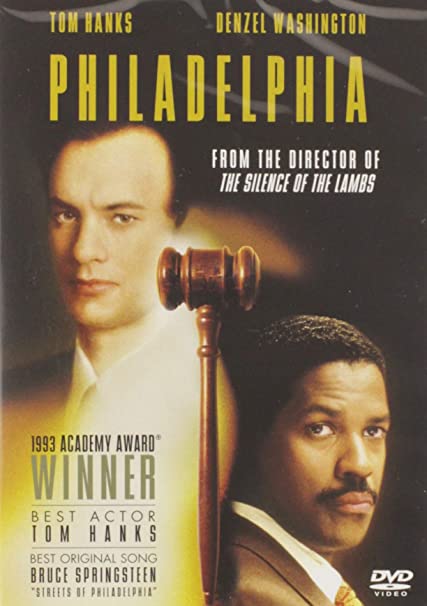
Jonathan Demme, the director, created an incredibly moving, emotional and sensational movie when he directed Philadelphia. This movie won two Oscar awards, one for best actor, which went to Tom Hanks, and one for best original song, which went to Bruce Springsteen, and it could not be more deserving of these awards. The sensitivity and care in the way that this film deals with the huge controversy surrounding `AIDS at this time is truly amazing.

Set in Philadelphia in the 1980s and 90s when the AIDS crisis was at its most severe in America, the film focuses on Andy Beckett, played by Tom Hanks, a promising young lawyer at one of the largest law firms in America. He is hugely successful, being offered a promotion to senior associate by his boss Charles Wheeler, played by Jason Robards. However things start to fall apart when we learn that Andy is a gay man who has contracted AIDS and that he has been fired by his boss because of this. Andy then asks Joe Miller, played by Denzel Washington, to be his lawyer as he wishes to sue Charles for wrongful termination. We see a great character arc represented in Joe as we see him go from an incredibly homophobic man which was sadly quite common at this time, using homophobic slurs, backing away from Andy when he discovers he has AIDS etc, to helping Andy to fight in court and supporting him even outside the court room. The majority of this film is set in a law court as we see the legal battle between Charles and Andy played out in full: Charles continuously lies saying that Andy was not a satisfactory lawyer, that this was the reason he was terminated and that he was unaware that Andy had AIDS. I won’t spoil the rest of the film as I feel like there are points that are better to watch without any prior knowledge but it is definitely worth watching.

I would say that this film is definitely deserving of five stars and I can honestly say that it is one of the best films I have ever seen. The AIDS crisis in the late 20th century was such a prevalent issue and has so much stigma and controversy surrounding it. From 1981 to 1990, 100,777 people died of AIDS in America so it was clearly a very deadly and aggressive virus. This led to lots of fake news surrounding AIDS, such as the popular belief that it was an airborne virus and that it was caused by gay sexual relations. In extreme cases people believed that it was a punishment from God. Thus leading to many people being too scared to be in close contact with people who had contracted AIDS and people using it as an excuse to be increasingly homophobic: as we see in the film in cases such as when the defending lawyer accuses Andy’s infection of AIDS as being his fault as he was having sexual relations with men.

This level of homophobia was sadly not just fictional as ‘Philadelphia’ is largely based on the true story of Geoffrey Bowers, a lawyer who sued his law firm in 1987 for wrongful termination in one of the first AIDS discrimination legal cases. The real life aspect of this movie adds a far more heart-wrenching feeling from start to finish and the level of not just homophobia but also of suffering that the AIDS patients endured does make it hard to watch. However, although harrowing and deeply emotional, I think that this is truly an excellent film not just because of its amazing script, acting and cinematography, but also because of the fact that it is reflective of the attitudes of many people at the time of the AIDS crisis. This makes it an important movie to watch and it is one that I would definitely recommend.

The Platform

Galder Gaztelu-Urrutia, a Spanish director born in Bilbao, made his feature film debut in 2019 with The Platform or El Hoyo in Spanish. The Platform is a Spanish dystopian horror film which many people view as a social commentary on the flaws of capitalist societies. The director, Gatzelu-Urrutia, said that the key message of the film is that “humanity will have to move towards the fair distribution of wealth.” This theme is evident throughout the movie, which gives it a much deeper, much more intelligent feel than most horror films.

The film starts with Goreng, played by Iván Massagué, waking up in a concrete cell marked with the number 48. He then realises he is not alone, and begins to question his cellmate Trimagasi, played by Zorion Eguileor, who explains that they are in a Vertical Self-Management Centre nicknamed The Pit. The Pit is a tower-shaped building in which food is placed on a floating platform and delivered to each level where it stops for a short time before continuing to descend. Food can also not be kept when the platform descends, and if it is the cell is heated or cooled to extreme temperatures until the food has gone again. The idea is essentially that as the platform descends, the food lessens so the people at the lower levels will go hungry and are at a disadvantage which reflects the disadvantage placed on people at the bottom of capitalist societies.

Each inhabitant is assigned to a new level at random at the start of each month and each resident is allowed to bring one item inside the facility with them. Goreng brought a copy of Don Quixote, whilst Trimagasi chose to bring a self-sharpening knife. He then reveals to Goreng that when he was assigned to level 132 with his former cellmate, they killed and ate one of the other inhabitants of The Pit in order to survive. A woman named Miharu, played by Alexandra Masangkay, then rides down on the platform and Trimagasi tells Goreng that she descends the levels of the facility on the platform each month to search for her child. It is then revealed that Goreng is in the facility as a volunteer but Trimagasi is serving a one year sentence for manslaughter.

When Goreng wakes up relocated to level 171, he finds himself tied up by Trimagasi who explains that since no food will come to them, they must eat strips of Goreng’s flesh in order to survive. A few days pass and as Trimagasi is growing weaker, in a particularly gruesome scene, he starts to cut into Goreng’s leg before he is attacked by Miharu who then frees Goreng. He then kills Trimagasi.

He then wakes up on level 33 with a woman named Imoguiri, played by Antonia San Juan, who is revealed to be one of the administrators of the facility. She tries to make changes within the facility telling the people below to only take what they need so that everyone can get food, but no one listens until Goreng threatens them. He awakes the next month on level 202 and sees that Imoguiri has hanged herself; he becomes overwhelmed and plagued by hallucinations of Trimagasi and Imoguiri encouraging Goreng to eat her flesh in order to survive, and in the end he does.

In the next month he is assigned to level 6 with a new cellmate Baharat, played by Emilio Buale Coka, who he convinces to ride down on the platform so that everyone can get a portion of the food. They descend until level 333 where they find Miharu’s daughter, who Miharu has been delivering food to each month so that she can survive. Goreng passes out and has a vision of Baharat telling him that the girl is the message. When he wakes up, he finds Baharat dead and he takes the child to the platform and puts her on and stands back and watches as she ascends on the platform.

This movie is definitely worth five stars as not only is it an extremely enjoyable movie, but it also has many clever hidden messages within it. The most obvious one is the commentary on the flaws of capitalist society, like the fact that the people on the first few levels are treated to a lavish buffet whilst the people on the lower levels get nothing at all, but there are many other deeper messages too. The girl could be described as the message because she is the only one who can make a change within the facility. In terms of real life, this could reflect the viewpoint that young people are the only thing that can save and develop society as they bring in a new way of thinking that can make real change. Even the characters names have meaning behind them: Goring means “fried” in Indonesian which points towards the fact that The Pit may in fact be a physical representation of Hell, Imoguiri is named after Imogiri which is a Javanese cemetery in Indonesia which emphasises that her, along with her colleagues are willingly sending people to their deaths. Finally, Miharu which means “to guard” or “to open one’s eyes” in Japanese emphasises her role as the guardian of her child who will change the inhabitants of The Pit’s way of life. Personally, I think it is one of the best horror movies out there and it is another one of my favourite movies so I would say that it is definitely worth watching.

The only thing I would point out is the level of graphicness depicted in the movie. There are several gruesome, violent scenes throughout, which are clearly used to depict the brutality of society, but I don’t think these take away from the enjoyability of the movie. So if you can cope with some violence, then I would absolutely recommend this movie.

mid90s

Jonah Hill made his directional debut with the movie mid90s, a coming-of-age comedy-drama set in 1990s Los Angeles. Hill drew on inspiration from his own childhood in the 1990s and this is evident from the clear sense of nostalgia throughout the movie. Hill was a keen skateboarder in the 90s and said that he wanted to properly represent skate culture in the 90s so decided to not only include moments from his own childhood, but also that all of the skating actors in the movies would be people who were skateboarders in real life.

The movie is based on a young boy, Stevie who lives with his older brother Ian, who is extremely abusive, and his single mother Dabney. The movie starts with a harrowing scene of Stevie being abused by Ian. One day Stevie sees a group of four skaters in a skate shop and returns home and begs his brother for a skateboard. He then goes to the skate shop and befriends the four skaters: Ruben, Ray, F*cksh*t and Fourth Grade. They teach him how to skate and take him under their wing, taking him everywhere with them including to parties.

When Stevie comes home intoxicated after a party, him and Ian get into a fight and Ian has a mental breakdown when Stevie points out his lack of friendships. His mother then bans him from hanging out with the other boys, but Stevie rebels and goes back to the skate shop. There, him and Ray have a heart-warming conversation about how the other boys help each other with their tough moments in life and he then takes Stevie out skating all night.

The skate shop then hosts a movie, where F*cksh*t gets incredibly intoxicated and tries to embarrass Ray in front of the pro-skaters who are trying to recruit him and Ruben and Stevie get into a fight in front of all of the other partygoers. F*cksh*t then attempts to drive the boys home, while still being incredibly drunk which results in a car crash and Stevie in a hospital bed.

The movie ends with reconciliation, Ian and Stevie are finally on the same page and their relationship is improving, Dabney allows the skaters to go and see Stevie after seeing them waiting for him in the hospital waiting room. The skaters then watch the movie, entitled ‘mid90s’, that Fourth Grade has been filming for the duration of the film and the movie ends with them all skating in Fourth Grade’s movie.

In mid90s, we see Sunny Suljic (a professional skateboarder and child actor) in his first ever lead role. He did an excellent job of portraying a young boy with many emotional and family troubles. The other skaters in the film: Ray, F*cksh*t, Ruben and Fourth Grade are also all professional skaters which helps to make the film seem more natural and realistic. Lucas Hedges portrays Stevie’s abusive older brother, and his acting is so good in this movie that you forget he is acting and it seems more like a documentation of a brother’s abusive behaviour. Katherine Waterson and Alexa Demie also star as Stevie’s mother and a girl with which Stevie has his first sexual experience respectively.

I think that this movie deserves four stars because it is very entertaining, very realistic, has many likeable characters – many of whom have excellent character development, and it also has a very good plot. The soundtrack is also a large reason for the amount of enjoyability in this film as as well as its own original music, it features many songs from the 1990s such as “Passin’ Me By” by “The Pharcyde” and “93 ‘Til Infinity” by “Souls Of Mischief” which definitely place the film in the 90s and give it a more nostalgic feel. There is also clever symbolism in the movie, such as orange juice which is used throughout the movie to represent the power dynamic of Stevie and Ian’s relationship. At the start of the movie, we see Ian drinking orange juice when he is being abusive towards Stevie and it is evident that he is the one with the power in the relationship. In Stevie and Ian’s big fight, we see Stevie injuring Ian and causing him to have a breakdown, and we see Stevie drinking the orange juice which represents the the power dynamic has now shifted so that Stevie is the one with the power. By the end of the movie, Stevie and Ian have reached equilibrium in their relationship. They both have a mutual respect and understanding of each other, and this is represented by them both drinking orange juice together as they are now on the same level of authority and power.

The reason I think that this movie is deserving of four stars instead of five is simply that there were many unanswered questions in the movie and many things that could have been developed and talked about more. An example of this is Stevie’s self-harm throughout the movie: there are many instances in mid90s where Stevie hurts himself in order to rid himself of guilt and punish himself but we never see how this started or whether it ends or continues. All the skaters also have their own issues that aren’t really talked about like Fourth Grade’s poverty, F*cksh*t’s drug addiction and alcohol abuse and Ruben’s abusive drug addicted mother. I feel like if these things were developed further the movie would have been even better and it would have been deserving of five stars.

Overall, I would say that mid90s is definitely worth watching as it is a very enjoyable movie and one of my own personal favourites. I would however say there are quite a few hard to watch, uncomfortable scenes throughout the movie. These include the previously mentioned abuse of Stevie by his brother and Stevie’s self harm, and also a long, sexual scene featuring Stevie and a much older girl. But if you can get over these things, then I would say this film is definitely one to watch!